Wednesday, July 16, 2014

How To Fit In A Ladakh Motorcycle Trip In 15 Days Starting From Delhi


A Ladakh motorcycle trip is something that is on the mind of a lot of people but planning it out seems very difficult. When I travelled I had the luxury of time. A lot of people do not have the same luxury and I'll try to plan a rough itinerary of a possible motorcycle trip to Ladakh and try to fit it in 15 days. Keep in note I am keeping the starting point as Delhi. The route mentioned is Delhi -> Pathankot- > Srinagar -> Leh -> places around Leh -> Manali and finally back to Delhi.

Most importantly keep these pointers in mind before starting the trip. One thing I forgot here was that prepaid numbers from non J & K states won't work here. So make sure you have a postpaid connection on your cell phone. A lot of areas in Ladakh, you might not catch a signal even then. But a vacation without cell phones is not really that bad a deal. :)

Day 1 - Delhi to Pathankot


  • Distance : 486.5 Kms
  • Yes you would have to push yourself a bit. But then its the plains and the highways are good enough.
  • Start early morning by 5 if possible and beat the city traffic. It easily saves you an hour or more
  • It should take you 12 to 14 hours including food breaks and all
  • You want to spend more time in Ladakh, trust me. So push yourself a bit on these initial days

Day 2 Pathankot to Srinagar


  • Distance: 363 Kms
  • Yes start early. I mean its always advisable
  • There is a route which you can take to bypass Jammu and reach Udhampur directly. Check on it. I had to go to a friends place in Jammu, so I never bothered. Moreover I always had the luxury of time
  • 12 - 13 hrs including food breaks. You will start spending time to click pictures

Day 3: Rest in Srinagar and roam around Srinagar


Somewhere close to the Hazrat Bal mosque
  • If you have never visited Srinagar before do spend a day here
  • Check out the Shankaracharya Mandir, Nishat garden, Shalimar garden, Hazratbal mosque. All of them overlook the Dal lake
  • For more pictures of Srinagar check out this link  

Day 4: Srinagar to Kargil


Enroute Kargil after the Zojila pass
  • Distance - 204 Kms
  • You will cross the Zojila pass, Dras town, Kargil war memorial before reaching the Kargil town
  • The roads aren't that great but I think its the view that slows you down more
  • You are sure to spend more time clicking pictures
  • Take it slow. Spend 14 hours on the road if you have to. The views are breathtaking.
  • Fill up petrol in Srinagar for sure. Although you will find some 3 to 4 petrol pumps on the way but still be on the safer side
  • After Kargil the next place you will find hotel rooms is probably Lamayuru some 100 Kms away. So stay the night at Kargil

Day 5: Kargil to Leh


Enroute Leh

  • Distance - 210 Kms
  • Fill up petrol in Kargil just to be on the safer side. Although you may find 3 to 4 petrol pumps on the way
  • You will pass through Lamayuru and the Magnetic hill
  • Finally you made into Leh. You will just love this feeling. But the best is yet to come, trust me
  • You can check the pictures of Srinagar to Leh ride here

Day 6: Leh


Leh city 

  • Get your permits for Nubra valley, Pangong Tso lake, Tso Moriri lake
  • Roam around Leh city. Check out the Hemis monastery some 40 odd kms from Leh
  • Get your bike checked and fixed in one of the workshops. After Leh the next place to find mechanics easily is in Manali
  • Although I have heard that from May 1st 2014, Indian citizens do not need a inner line permit for visiting these places. If true its a major relief. Foreign nationals would still need a Protected area permit though.
  • You can ask any travel agent in Leh for the permits or get it yourself from the DC office in Leh
  • For more pictures of Leh check out this link

Day 7: Leh to Nubra and back


Enroute Khardungla

  • Distance : 230 Km (115 Km one way)
  • It should take you approximately 14 hours including stops for pictures and everything. 
  • Start very early from Leh by 5 am
  • You will be passing through Khardung La - the worlds highest motorable point
  • When you reach Khardung la, click your pictures and continue forward towards Nubra. Since it is at such a high altitude. locals advise that you don't spend more than 30 minutes there
  • I just went till Khardung la and came back. I did not go to Nubra. I had to wait for 2 days in Leh before the Khardung la road opened because of unexpected bad weather. I did not want to risk going to Nubra and getting stuck there. When I went the weather played a little spoilsport
  • So yes the weather can be a bitch. Keep that into consideration
  • Be very careful on these roads. The roads can be very slippery at places. Drive carefully. Do not drive in the dark if possible. If you reach Nubra and you feel getting back to Leh before dark is tricky don't push it. Stay in Nubra for the night and come back the next day
  • FILL UP PETROL IN LEH
  • You can check out the Leh Khardung la pictures here

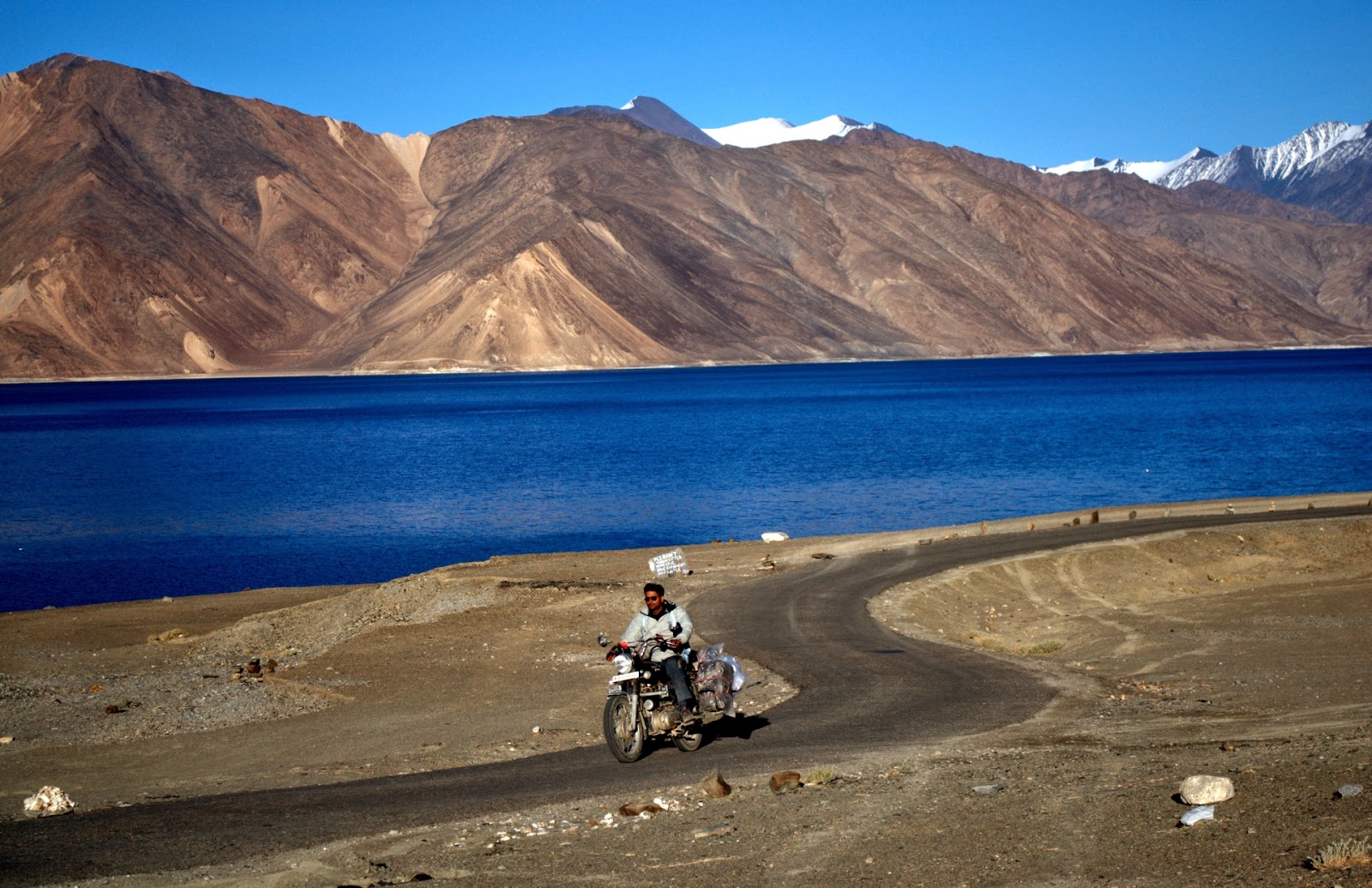
Day 8: Leh to Pangong lake


Image Source

  • Distance - 214 Kms
  • Fill up petrol in Leh and carry some extra petrol with you - 10 litres. I am assuming you will come back to Leh the next day
  • I skipped Pangong lake because of some issues.
  • I do regret that

Day 9: Back to Leh from Pangong

  • There is a route which can take you from Pangong to Tso Moriri directly. This would save you a day
  • However I am not sure of the permits thing in that route. I am more or less sure that foreign nationals are not allowed on that road. Check up on that. 
  • If you are taking that route and subsequently you are heading to Manali, make sure you are carrying enough petrol to last you some 800 - 900 Kms when you start from Leh on Day 8

Day 10: Leh to Tso Moriri

  • Distance - Around 230 Kms. Google maps doesn't show it but I know since I did it
  • After travelling some 200 Kms you will find a beautiful lake and most probably you would assume it to be the Tso Moriri lake
  • But its not. The road disappears when you almost pass this lake
  • The last 20 Kms is a stretch without any roads. These are just jeep tracks. Pray that you don't encounter any flat tires but be prepared for it
  • Fill up in Leh when you start and carry enough petrol to last you some 600 to 650 Kms.
  • The 600 - 650 Kms is including the petrol already in your tank

Day 11: Tso Moriri to Sarchu

Somewhere on the TsoMoriri - Tsokar - Sarchu route

A place to sleep for the night in Sarchu
  • Distance approximately 220 to 250 Kms
  • The roads from Tso Moriri via Tso Kar to Sarchu alternates between good and non existent till you hit the Leh Manali highway some 40 odd Kms before Pang
  • You might only find very modest places to sleep like the tent dhaba in the picture above
  • They are quite comfortable and one bed was available at Rs 100 a night. 
  • I do hope you still have some petrol left for atleast another 100 to 150 Kms :)

Day 12: Sarchu to Manali

Sarchu - Manali route
  • Distance - around 230 Kms
  • You will be crossing Rohtang pass before reaching Manali
  • Reach there and relax a bit. Its all downhill after that. Literally
  • You can check out the pics from Leh onwards here

Days 13 to 15: The boring part

  • Its all downhill from here
  • Maybe spend a day in Manali, fix your bike and do the stuff you want to :)
  • Manali to Delhi is 539 Kms. Maybe you want to split it in two days or do it in one by pushing yourself
  • Figure it out yourself. 

General tips

  • Once you cross the Zojila pass after Srinagar and enter Ladakh population is very sparse. So take care of your diet and hydration and keep ample stock. You might encounter places where you travel for some 100 - 150 odd kms without spotting any shops or civilization
  • Always carry extra cash around 4000 to 5000 bucks just in case of an emergency. ATM's may be sparse once you leave the towns.
  • It does get cold. Make sure you have sufficient woolens. Keep spare dry woolen socks handy. A lot of places you may be crossing streams and you might feel the need for a fresh pair of socks.
  • Woolen caps that cover ears under your helmet, woolen gloves under your biking gloves and anything woolen is strongly advisable
  • I tried to fit it in 15 days. Obviously there are a lot more places to see in Ladakh. 
  • Please do feel free to add stuff in the comments section which can make this itinerary a lot more better and other places whch could be fitted in.
  • This is a rough itinerary. Do you research and skip parts you are not very keen on and add some other which you can fit in
  • I hope this does help a bit. 
About Me:

A 7 month motorcycle ride that took me to every state in India, parts of Nepal and Bhutan and one town in Burma. These blog entries are inspired by this trip. Stories about people I met, stories about places I saw. Things that intrigued me, things that amused me. They say traveling changes you, they say traveling inspires you and they say a lot of other stuff. I don't know. I think a gun on the head is a better way to change people. I just hope that my travel stories entertain you

Right now I am in the process of writing a book based on this trip and figuring out the difference between a writer's block and procrastination.

You can find more information on my Facebook page and Instagram account

Saturday, July 5, 2014

When Maria Sharapova Was Asked About The Clueless Rider

A small excerpt from the Maria Sharapova post match press conference

Do You Know Sachin Tendulkar ?


Do You Know About The Clueless Rider ? 


The Clueless Rider (The link Maria was talking about)


Do Like / Share the page if you liked it :)

Tuesday, June 24, 2014

15 Things To Keep In Mind While Planning Your Ladakh Motorcycle Trip


Leh is definitely one of the most beautiful places in India and you should definitely visit this place at least once in your lifetime. In case you love riding motorcycles and do go on motorcycle trips here and there, trust me its a crime if you don't take your bike there. Keep these pointers in mind and go ahead and do that Leh motorcycle trip you always wanted to.

1) The Routes

There are two major routes to reach Leh. The Jammu -> Srinagar -> Leh highway and the Manali ->Leh highway. Both routes are extremely scenic and I would personally suggest that you take one route while going there and the other while coming back.

Srinagar Leh Route

Srinagar Leh Route


Leh - Manali Route

Leh - Manali Route
Although for whatever my experience counts, I think its better to take the Srinagar highway while going and taking the Manali route while coming back as the ascent to higher altitudes is more gradual in the former route and acclimatizing yourself to the altitude is easier in this way.

2) The best time to travel

The roads to Leh are only open for about 6 months a year for the tourist on both the routes. Starting from mid May - June first week to about mid October - November. So the months from June to September should be a safe bet. But then July August being monsoons could get a little tricky on the passes (Zojila pass in the Srinagar - Leh highway, Rohtang pass on the Manali - Leh highway). So basically June and September are the best months to travel but hey you can always be a little adventurous in the monsoon months.
Zojila pass. Although I was there in June, it was raining that day. Monsoons would be far worse I guess
P.S. If you are travelling around Independence day (Aug 15), the Kashmir valley can upset your itinerary a bit as a lot of separatist groups call out bandhs and strikes during this period.

3) Altitude Sickness or Acute Mountain Sickness (AMS) is a real bitch. Taking some precautions doesn't make you a wimp

Different people have different immunity levels towards altitudes. You are the best judge on how much your body can take. Some people are severely affected and some are just mildly affected. A mild case of AMS just feels like a slight hangover. Thankfully I was just mildly affected and however stupid it sounds, I have been drinking since the age of 18, so I knew how to deal with a mild hangover. However read up on AMS and the precautions, medicines etc you can take before you start this trip

4) Drink a lot of water, eat properly and keep some sweet stuff handy

The internet is full of articles on the health benefits of water. Trust me its not overrated. I am generally not very particular about my eating habits but once I hit the higher altitudes after Srinagar and till the time I wasn't back in the lower altitudes of Manali, I religiously ensured that I have 3 to 4 litres of water everyday, proper meals and chocolates / biscuits for energy every now and then.

5) Wear a Balaclava or use a piece of clean cloth to cover your mouth while riding in very high altitudes


Image Source

At high altitudes oxygen levels are low. One tends to breathe from the mouth when riding on high altitudes. Since you are breathing hard, you could end up inhaling water vapours present in the air and water could deposit in your lungs. Sounds scary. Ok I read about this somewhere before the trip. I am not really sure if it is true. But then why take chances. Although I must add, when I stopped in between rides, I could feel the wetness in the cloth that covered my mouth.


6) Go easy on the alcohol. Trust me, the views are enough to give you a high

And you thought I was kidding
I love alcohol. I make no bones about it. But drink responsibly. Alcohol causes dehydration and does not really help with altitude sickness. Know your limits and try not to reach there. Never ever push the limits in these parts.

7) Leh isn't exactly the place to try this out

Warning: Do not try this in Leh
Image Source

Do not physically exert yourself too much in these parts. Even brisk walking in such high altitudes can take a toll on you. Take your own sweet time for anything you do. After all a vacation is just meant to slow down your life a bit. Conserve as much energy as possible till the time you feel you are very well acclimatized.


8) Points 3 to 7 are not to scare you. It's just that it doesn't hurt to be careful

Frankly I did not face any health issues and I guess most people will not. I can act all cool and frivolous about it but then I did take precautions. I did happen to meet people on the way who suffered from some sort of AMS in these parts. So once again, do read up on AMS before you embark on your Leh trip. If you feel any discomfort do stop and enquire in Army camps for medical treatment (They have oxygen cylinders and other such stuff) and check about medicines you can or cannot have
Again I am not sure of this but I did hear Dispirin for headaches is not advisable in such high altitudes.

9) Inner Line Permits / Protected Area Permits in Leh

Indian citizens require Inner Line Permits (ILP) and foreign nationals require Protected area Permits (PAP) to travel to Nubra Valley, Pangong Tso lake, Tso Moriri lake etc. You can find a lot of tour operators in Leh city who can arrange this for you or you could just head to the DC office in Leh and get the permits yourself. Will turn out to be a lot cheaper if you do it yourself and its not a very complicated process. Keep some extra passport size photographs with you when you are travelling to Leh.

P.S. It seems like there is a circular issued by the Leh DC office that starting from May 1st 2014, Indian nationals do not need an ILP and they just need to provide a valid photo id in the checkposts to go to the above mentioned places. However foreign nationals still need to get PAP. However I am not completely sure of it. Please do check about the veracity of this information. If true, its a huge relief. 

11) Wear protective gear. However headmasterish it sounds, it does save lives and limbs

These are very remote areas with no signs of humanity across long stretches. Medical attention in case of an untoward accident may be a little difficult. I had a really bad accident and I had to ask a truck to carry my bike some 300 Kms from Sarchu to Mandi across the Rohtang pass but thankfully owing to my protective gear I was unscathed.
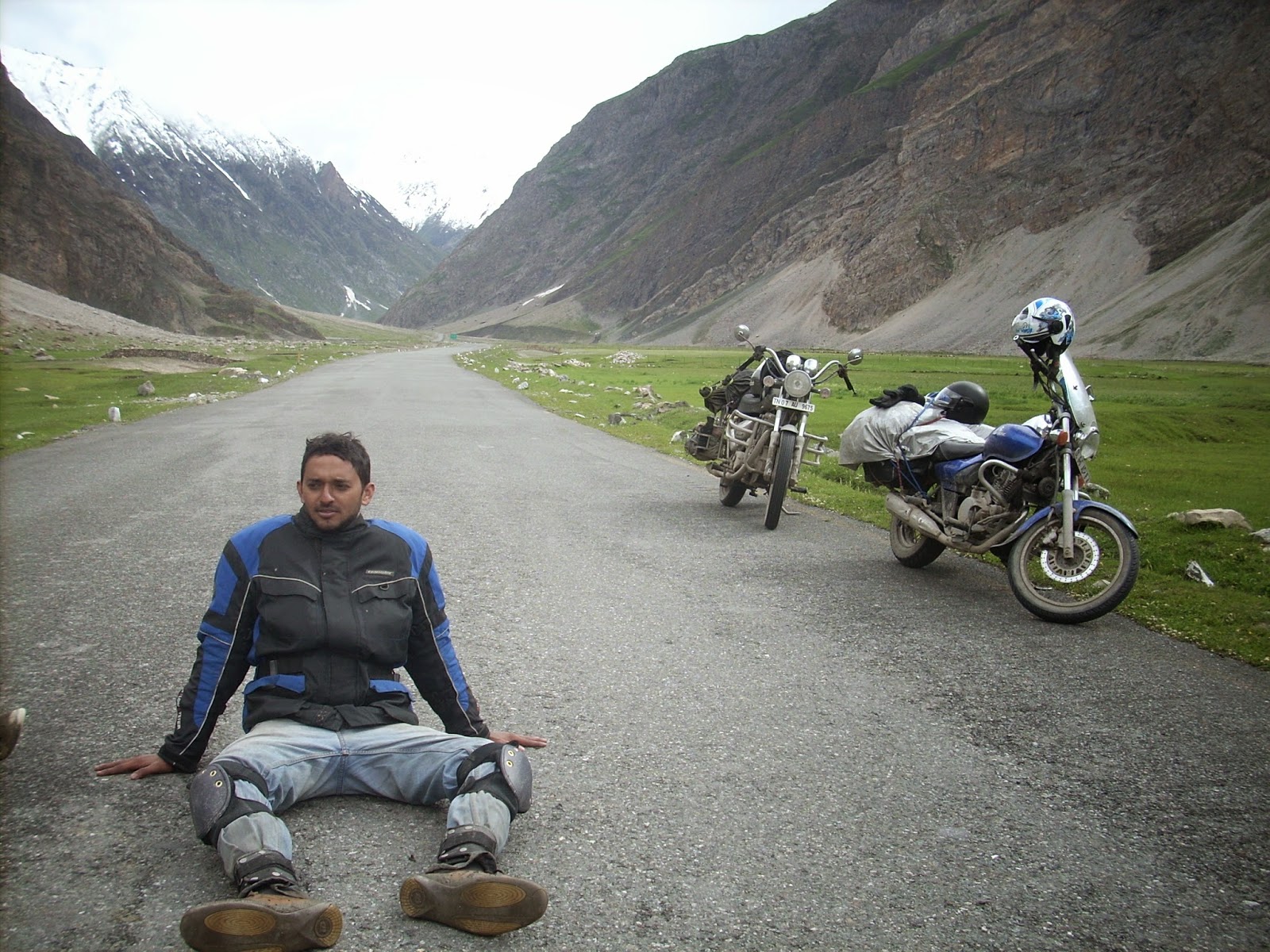
These protective gear are a life saver
It kinda looks cool too.

Just for context, this is how the bike looked after the accident


12) Carry some extra petrol in some stretches

Specially on the Leh Manali highway and say if you are travelling to Pangong Tso or Tso Moriri lakes. Like I mentioned before, these are vast stretches without any humanity so expecting a petrol pump might be a little too optimistic. Its not uncommon to find that you have covered some 300 to 400 Kms without a petrol pump in sight.
Forget humanity, I do not think anything lives in these stretches
Although the few and far in between villages that you cross, you may get to buy some petrol in the black market at more expensive rates. But not advisable to buy from the villages as the petrol could be spurious and could be a little troublesome for your vehicle. The Jammu to Leh highway is alright. Fill up in Srinagar. After Srinagar the frequency of petrol pumps will reduce but then you will have one in say every 150 to 200 Kms

13) Carry motorcycle spare parts, get a mechanic to check your bike in Leh and if possible learn some basic things about fixing your bike.

Carry extra clutch cables, accelerator cables, fuses, tubes, a puncture kit, air pump etc along with you. From Jammu to Srinagar to Leh you will still find mechanics on the way. These mechanics may have the skills to fix your bike but maybe not the bike spare parts you require. Ask your local neighborhood mechanic for some lessons and common problems and fixes before you start the trip. On the Leh - Manali stretch, you will hardly find any mechanics. So get your bike checked by a mechanic in Leh. There are lots of them there.
But most importantly keep praying that nothing goes wrong.

14) Be nice to every truck driver on the way. Build on your Karma points


If things go very wrong, trucks are your best way out. These guys have the space to carry your bike to the next town when you are in a absolute fix. Truck drivers are nice people and will help you out although some negotiation skills may be handy

15) Keep some days spare in your itinerary if you have that luxury

Your itinerary can be upset for a host of reasons. Some roads may be closed because of weather conditions, you might need a little more time acclimatizing, your motorcycle develops a snag and takes time to fix


About Me:

A 7 month motorcycle ride that took me to every state in India, parts of Nepal and Bhutan and one town in Burma. These blog entries are inspired by this trip. Stories about people I met, stories about places I saw. Things that intrigued me, things that amused me. They say traveling changes you, they say traveling inspires you and they say a lot of other stuff. I don't know. I think a gun on the head is a better way to change people. I just hope that my travel stories entertain you

Right now I am in the process of writing a book based on this trip and figuring out the difference between a writer's block and procrastination.

You can find more information on my Facebook page and Instagram account

I am sure there are a lot more things to this list and possibly some mistakes in this list. Please do add / correct them in the comments for the benefit of anyone who is planning a trip. Also if someone has more info about the Inner line permit circular do mention in the comments.


P.S.
Click this link for Srinagar to Leh pics
Click this link for Leh pics
Click this link for Khardungla pics
Click this link for Leh to TsoMoriri pics 


Tuesday, June 17, 2014

The World Is A Much Kinder Place Than What Its Generally Given Credit For


Me: "Sir yahan pe ATM kahan hoga" (Where Can I find an ATM here)

BSF guy: "Yahan Moreh mein toh koi ATM nahi hai" (There are no ATM's here in Moreh)

Me: "Aas pas koi ATM hai. Mere jeb mein sirf 120 rupaiye hain aur mujhe raat ko hotel room book karna hai yahan" (Is there some ATM nearby. I have just 120 Rupees in  my pocket and I need to get a hotel room for the night)

BSF guy: "ATM toh aapko Imphal mein hi milega" (The nearest you'll get an ATM is in Imphal)

Yes many good stories start by "I only had x amount of money in my pocket" and this one is no different. Here I was standing some 500 meters from the Burma border in Moreh with Rs 120 in my pocket and the nearest ATM some 100 Kms away in Imphal. The funny part is that I was actually coming from Imphal after checking out of the hotel late in the morning. Even more funny is the fact that since clearing the hotel bills had left me with Rs 120 in my pocket I had gone to an ATM just outside the hotel and seeing a queue of some 8 people waiting to withdraw cash, I in my impatience decided to hit the road and withdraw cash from some ATM on the way. Seems practical enough except for the fact that I conveniently forgot about withdrawing cash. In my defense I can only say that riding on the roads can be such a high that often it makes one forget a lot of things.

So here I was on the side of the road lighting up a cigarette and taking stock of my situation (Statutory warning: Cigarette smoking is injurious to health). I was screwed. Moreh was one place I was eager to explore (See the entry on Moreh here) but Rs 120 would not even get me a hotel room, let alone other things. I could try if the hotels would accept cards but when the nearest ATM is some 100 Kms away, one can make an educated guess that it would be a near impossibility. Heading back to Imphal was also difficult as it was already past 4 and the security situation in Manipur ( read entry on Manipur here) makes it impossible to drive on the roads once its dark. I was totally screwed. The thought that "The Clueless Rider" was such an apt name for my trip suddenly struck me. I did manage a wry smile at that.

They say when death is staring at you, your whole life flashes before you. Let me give you another pearl of wisdom from my travel experiences. "When you end up in a soup, you identify the point which led you into this situation and starting from that point in time, your life flashes before you". Standing there on the side of the road all images were flashing before me. The queue outside the ATM, the hustle and bustle of the Imphal city, getting out of the city and riding through the Imphal plains, paddy fields on both sides of the road and a mountain on the horizon in front of me, reaching that mountain and starting the ascent to the mountain which in another 65 - 70 odd Kms will take me to Moreh, the innumerable police and Assam Rifles checkposts (some 6 to 8) in that 70 Km odd stretch where I had to stop and prove my identity and intentions. Suddenly the flash of images paused at one particular police checkpoint and I knew I had found the rope to cling on and get out of the swamp.

There is a Tamil community settled in Moreh (Read that story here). On one of these checkposts, I had met a Tamil guy on his way to Moreh and we had struck up a conversation. Pretty normal when you are dressed up in a biker attire and the fact that my motorcycle had a Tamil Nadu registration just helped matters. He had invited me to visit the Tamil Sangam office when I was in Moreh. I had other things in mind and I made a mental note that I would pay him a short courtesy visit the next day on my way back. But desperate times call for desperate measures and I had to seek the help of the Tamil Sangam. The earnestness in his invite just gave me the confidence that my night stay will be taken care of and I will have a wonderful story to tell people about once I am back and trust me the story just gets better.

Hope is a wonderful thing. In a split second I had everything sorted out. I have Rs 120 in my pocket. I'll ask the Tamil Sangam for a place to put up for the night. Spend not more than Rs 70 on dinner. The next morning keep aside Rs 10 for the entry ticket to Burma. (You can take your vehicle till the first town Tamu some 12 Kms inside on the Burmese side of the border without any documentation processes). Skip breakfast. Head back to Imphal with Rs 40 in your pocket in case of any emergencies. This time make sure to withdraw cash from the ATM even if a hundred thousand people are in queue. Check into hotel and eat like a pig. With the comfort that this small ray of hope provided, I headed to the Tamil Sangam office in Moreh.

I reached the Tamil Sangam office and there were two men seated inside. I told them my sob story and about the Tamil guy I had met in the checkpost and requested them to help me out. They said their secretary is about to them and I waited for him indulging in some small talk with these guys. Soon the Tamil guy I had met on the checkpost arrived and very shortly after that the secretary too arrived. He too lamented about the fact that there are no ATM's in that town but added that SBI ATM was going to be open next month. I replied that I might not be staying here for a month. I only planned to stay one day here. I don't think he got my humour but he did get my predicament and a room was arranged for me. The generosity did not stop there. I was provided dinner by them, the next morning I was provided breakfast by them and they even sent one of their workers to accompany me to Tamu in Burma the next morning. Even the Rs 10 entry ticket was paid by the Tamil Sangam.

But there's more to the story. A man named Anand Rao had accompanied me to the restaurant for dinner the previous night. Over dinner and after dinner we had a conversation on the history of the town, the political and millitancy issues in these parts and a host of other things. As I was about to head to my room, he took out a 1000 rupee note and handed it to me. I was overwhelmed. I told him that I did not need the money as my needs have been more than taken care of. He insisted by replying nonchalantly that they pay more ransom money to the millitant groups and the police there and its a non issue and it will be helpful in case of some emergency on the way back. I kept the money not because I needed the money that much but more because I needed this memory. All my requests for details about his bank account to enable me repay the amount by online transfer later on fell on deaf ears.

The next morning as I was about to leave, I tried convincing the Tamil Sangam secretary for a bank account number so that I can transfer the money back. I don't know what he understood but he told me there is no need to transfer the money but to write an application that "Rs 1000 for George Aikara so and so on a all India bike trip in Moreh on 3rd and 4th Sep2013". I wrote that application and was about to start my bike when a guy comes in and hands me another Rs 1000 note. I clarified that I had already got the money yesterday from Anand and I did not need more cash. The Secretary responded that Anand gave that on personal capacity and this 1000 rupees is from the Tamil Sangam. This time I just refused. I thanked everyone profusely and left off to Imphal.

I had come in with Rs 120 in my pocket and I was leaving with Rs1120 which could easily have been Rs 2120. If you ever happen to be in Moreh, do visit the Tamil Sangam and ask them about me. I will remember them fondly throughout my life and I hope they do too. Also if you happen to meet Anand Rao, please buy him a beer.

And yes the SBI ATM might have come up in Moreh by now, but carry enough cash anyway :)

About Me:

A 7 month motorcycle ride that took me to every state in India, parts of Nepal and Bhutan and one town in Burma. These blog entries are inspired by this trip. Stories about people I met, stories about places I saw. Things that intrigued me, things that amused me. They say traveling changes you, they say traveling inspires you and they say a lot of other stuff. I don't know. I think a gun on the head is a better way to change people. I just hope that my travel stories entertain you

Right now I am in the process of writing a book based on this trip and figuring out the difference between a writer's block and procrastination.

You can find more information on my Facebook page and Instagram account

Sunday, May 18, 2014

The story of the Tamil settlement in Moreh, Manipur on the Burma border

Here's the link to my previous entry
http://thecluelessrider.blogspot.in/2014/04/a-town-called-moreh-somewhere-on-burma.html


Moreh is a place 100 Km to the east of Imphal on the Burma border. To be honest, there is nothing noteworthy about this town / village that people would want to live there - let alone visit. But history has been kind to this place. When the British empire left the subcontinent and national boundaries were being redrawn, Moreh got a good deal. It became the town which separated one country from the other, and that changed its destiny. The destiny did not change overnight. It took time and it took a race of people completely different from the indigenous tribes of people inhabiting these parts.

The northeast, in general is a place with a demographically diverse set of people and Moreh is no different. However when one of these sets is a Tamil population, one can be pardoned for being surprised to say the least. After all it is quite an inaccessible place miles away from Tamil Nadu and not really a place with its inherent militancy issues, that would prod people to migrate in search of a livelihood. No wonder the first time I heard it I was very much intrigued.

To understand how a Tamil population ended up here one has to go back to the time when the sun hadn't set on the British empire and the whole of India and Burma were under British rule. A lot of Tamilians had set off to Burma during that time to work there and when the British left in 1947, the Tamil population stayed back in Burma as they had built a thriving community over generations. However in the 1960's when the military junta government took over Burma, a lot of the non indigenous communities fearing atrocities, headed back to their original host countries although I may add quite a few stayed back. These Tamil communities reaching Tamil Nadu, 2 to 3 generations down did not feel very welcome in Tamil Nadu and decided to go back to Burma. The political situation in Burma being what it was, the only route to go back was via the land route through Moreh. They took that route and reached the Moreh village (I was told by the Tamil population residing there that Moreh at that time was just a jungle and even today when I have visited that place, I am still confused as to whether it can be called a town) to cross over to the Burmese side. The Burmese authorities denied them permission to enter the country and these people just settled down in Moreh. One really has to admire their industriousness as slowly they set up a trade chamber for the import / export of commodities across the border using their erstwhile connections across the border to good effect.

The period from the late 60's to well in the 90's business was good. At one point there were close to 1500 (from what the people over there told me) Tamil families living in Moreh. In monetary terms it was significant enough and wresting authority and control over this trade was a lucrative proposition for everyone involved. Aided with the absence of the law and order machinery, the Tamil groups had their own sets of gangs with muscle men armed with sticks dictating the power equations in that region. Border towns everywhere are notorious for the smuggling of expensive goods and contraband substances and Moreh was no different. Allegations flew thick and fast (and maybe there is some truth to it) that the Tamil gangs also had their interests in the drug trafficking arena. Pretty soon word started spreading about the flourishing inter border trade and slowly other players wanting a share of the pie started getting interested.

The lure of wealth attracts a lot of unwanted elements and sometimes it changes the existing power equations. Underground militias from the indigenous Manipuri tribes started taking interest and pretty soon they neutralized the Tamil gangs prevalent in these parts. After all the militias from the indigenous tribes came with guns. Stick wielding Tamil musclemen gangs were no match for the gun wielding militias. Presently as is the common knowledge in these parts militias from the Kuki tribes are the helm of the power hierarchies in this region and the Tamil gangs fight for dominance are restricted to their own communities.

Another thing adding to the woes of the Tamil community is the fact that since the late 90's and early 2000's Chinese goods started flooding the Burmese markets and demand for Indian goods reduced considerably. The changed power equations and the Chinese goods flooding the Burmese market have hit the fortunes for a lot of Tamil families, who were just modest small time traders. They no longer found Moreh lucrative enough to reside in. A lot of them have left the place for good. Still there are some 400 odd families left in Moreh and the Moreh chamber of commerce is still headed by a Tamil body. There is a Tamil mandir replete with Tamil architecture and a Tamil Sangam (sort of an NGO) which has pretty well ensured that the Tamil culture is preserved in this community. 

Moreh is undoubtedly one of the most cosmopolitan villages I have encountered on my motorcycle trip. Apart from the Tamil community, there are some 4 to 5 Sikh families, laborers from Bihar, Jharkhand & Orissa, some families from Andhra, a sprinkling of people from a few other states and of course the local Kuki and Meitei people. These people live under the shadow of the gun with the militia pretty much running a parallel government. But human beings everywhere are survivors. As the Tamil guy I was chatting up with in the evening told me "There are some 5 to 6 underground groups active here. We pay taxes to all of them and yes to the policemen too"

Oh yes btw the next morning I had idly sambhar for breakfast. Something for the stereotypes :)  

The Tamil community in Moreh helped me when I was stranded in Moreh with only Rs 120 in my pocket. You can read that story here
http://thecluelessrider.blogspot.in/2014/06/the-world-is-much-kinder-place-than.html


About Me:

A 7 month motorcycle ride that took me to every state in India, parts of Nepal and Bhutan and one town in Burma. These blog entries are inspired by this trip. Stories about people I met, stories about places I saw. Things that intrigued me, things that amused me. They say traveling changes you, they say traveling inspires you and they say a lot of other stuff. I don't know. I think a gun on the head is a better way to change people. I just hope that my travel stories entertain you

Right now I am in the process of writing a book based on this trip and figuring out the difference between a writer's block and procrastination.

You can find more information on my Facebook page and Instagram account

.


Wednesday, April 23, 2014

A town called Moreh - somewhere on the Burma border and how the hell did Tamilians end up here (part 1)

Here is the link to my previous blog entry
http://thecluelessrider.blogspot.in/2014/04/manipur.html

I am more of a night person. Its cooler, quieter and activities which may be described as immoral in the daytime seem more acceptable once its dark. Even if the immoral activities that I long for elude me, I still like to walk around in a new place at night time. The good people are all asleep and the wicked ones carry on with their activities in the cover of darkness. There is always a fear, a fear that there is something dangerous lurking around the corner waiting to pounce on you. Shady bars, groups of men couched together talking in hushed tones, in languages you don't understand when you pass by them in dingy street corners, specially in places where you clearly stand out as an outsider is one hell of a high few drugs can match upto. For all the beauty Manipur is blessed with - the security situation prevalent in the state really screws it up for everyone. Imphal - the capital city shuts down by 5:30 to 6 pm and after that one has nothing to do except for sitting in hotel rooms and wait for the sun to come up the next morning. I am not very particular about following the rules laid out and I do bend them once in a while to suit myself. But one look at the menacing looks of the Manipuri policemen carrying sophisticated weaponry and I know this is not really the place where I would be bending rules for frivolous purposes. The only silver lining in this mess is that the hotel waiter can get you alcohol from the black market to your room. Even though Manipur is a dry state, alcohol is very easily available and even the black market prices for alcohol seem reasonable (in fact cheaper) if you are used to buying alcohol in say a Mumbai or a Bangalore.

So everything was according to plan. Roamed around in the city the next morning. Went to Loktak lake some 40 odd Kms away on the morning after that. Came back to Imphal before lunch time. Headed to a cyber cafe to check out routes and other stuff to my next destination Silchar. But somewhere deep down I did not have enough of Manipur. Every traveler I believe is a journalist at some deep level and Manipur is one hell of a place to get a good story. I was still looking for my story here. I started researching about Manipur sitting in that internet cafe and I stumbled upon this town called Moreh. 'Moreh is a small town some 100 odd Kms away from Imphal on the Burma border' is the first thing I read from one of the articles I stumbled upon and by the time I finished reading more articles about Moreh I was sold.

Firstly I came to know that one could take their private vehicles to Tamu - the first town on the Burmese side of the border some 8 Kms inside without any documentation formalities. The third foreign country my bike would enter - leave apart everything else, this prospect itself was enough to get me going to Moreh. Then there is this Tamil Sangam in Moreh. There are some 400 odd Tamil families residing in Moreh and how they ended up in Moreh is a very interesting story. I will elaborate this story in my next blog post. Also the more I read about Moreh, I came to know that insurgent groups over there in the border areas control the allegedly flourishing drug trade across the borders. This town also claims to be more cosmopolitan than the rest of Manipur as Burmese alcohol is openly sold in the shops over there and the shops don't close till 8 or 9 in the evening. Considering the rest of Manipur closes by around 6 this was pretty interesting to note. Some articles also mentioned that there is a burgeoning sex trade in Moreh with women coming from Burma offering their services. Don't get me wrong. I was not keen on availing these services but somewhere the dark side of things intrigue me.

Drugs, sex and alcohol. One I indulge in regularly, one occasionally and one hardly. In no particular order mind you. I'll just leave it to your imagination. Sitting in that unimpressive cyber cafe I was already imagining myself sitting in a bar in Moreh, with hot women dancing around the table and people snorting cocaine on the other table. Somewhere I also imagined loud gunshots outside the bar where armed men on horses are fighting each other. Yes I was still wearing my cowboy hat and finishing off my beer when that hot waitress comes seductively with the bill. I tip her handsomely and leave for my hotel room. Something broke this lovely dream I was having sitting in that internet cafe but I was convinced that this is the place where I will get my story.

After all the best stories always involve drugs, sex and alcohol. The prospect of gunshots (which is very real in Manipur) would only spice up the whole story. So I did head up to Moreh the next day. I did get my story and boy what a story. Its probably one of the best stories I'll ever  have in my life. One I will irritate my grandchildren with. I'll come up with that story in my next post but I can tell you one thing

"The best stories do not involve drugs, sex or alcohol. The best stories are created when people are kind to one another"

About Me:

A 7 month motorcycle ride that took me to every state in India, parts of Nepal and Bhutan and one town in Burma. These blog entries are inspired by this trip. Stories about people I met, stories about places I saw. Things that intrigued me, things that amused me. They say traveling changes you, they say traveling inspires you and they say a lot of other stuff. I don't know. I think a gun on the head is a better way to change people. I just hope that my travel stories entertain you

Right now I am in the process of writing a book based on this trip and figuring out the difference between a writer's block and procrastination.

You can find more information on my Facebook page and Instagram account

Saturday, April 5, 2014

Manipur

Hindsight is a wonderful thing. It allows you to describe an event with a lot more clarity in your thoughts. When I think back of my trip almost all of the time Manipur is the first thing that comes to mind. There are certain points in a trip like this that has a great impact on you. Manipur was one such place.

Manipur is an incredibly beautiful place. Hills on the sides, a vast central plain in the valley where Imphal is located with lush green paddy fields on both sides of the roads - its a delight riding a motorcycle there. Sadly this is not what is newsworthy in Manipur. Manipur is home to a large number of insurgent groups around 25 to 30 in an area of 22,327 sq Kms and is probably one among the most militarized zones in the world. Much more sadly even this fact rarely makes the news in the mainstream Indian media.

Manipur is primarily inhabited by the Meities, Kukis and Nagas. From each of them, a set of insurgent groups have sprouted up with aspirations ranging from a separate state to independence. What all of them have in common is that they have taken up guns to fulfill these aspirations. Meitie groups fight for an independent country, Naga groups fight for a greater Nagaland state ie to merge Naga dominated areas in Manipur with the Nagaland state, Kuki groups fight for a separate state for the Kukis. Although on a lighter note, I do like the idea of a separate state for Kukis as it will be called Kukiland. Who wouldn't like such a name. Anyway apart from these insurgent groups, just to spice up things for the people of the state there is also a commando unit of the Manipur police - very notorious for ruthlessly putting out any sort of opposition. The kinds who would prefer encounters over arrests. Then you have Indian Reserve Battalions (IRB) and the Assam Rifles who sometimes assist the Manipuri police in anti insurgency operations.

The political situation in Manipur is quite a complex one and one should never try to simplify such complex situations by assigning heroes to one side and villains on the other. Heroes invariably end up on your side while the villains are always on the other side. Everyone has their selfish interests and maintaining the status quo probably suits them. If you talk to people they will tell you that the insurgents extort money and the policemen do the same. The security situation ensures there is lesser accountability which makes the politicians task of siphoning money much easier. The AFSPA (Armed Forces Special Powers Act) adds to the woes. I am not a security expert to suggest that it should be repealed but when a woman (Irom Sharmila) has been on a peaceful hunger strike from Nov 2000 the country should take notice. Repealing it may or may not be feasible but I am sure a lot could be done to make the act more humane and the security forces more accountable for the violations they commit under this Act.

A person holding a gun looks appealing only when you trust them completely. It does not matter if they are wearing a uniform or they are part of an insurgent group. The police commandos who move around in Imphal have such menacing looks - it scared the hell out of me. I ensured that I never prolonged eye contact with them. In Army checkposts I am more comfortable. A father who has served in the Army helps. The other civilians present - the local Manipuris are dealt with a lot of arrogance almost bordering hostility in these checkposts. Perceptions matter. The forces stationed in Manipur could undergo some lessons on people skills. Otherwise it runs the risk of looking exactly like what some people will term it as - an occupying force out to colonize the state.

Manipur and more generally the north east is greatly ignored by the country. If I give out an India outline map to 15 year old kids with state boundaries outlined, I don think more than 20% of the people (I am being optimistic) will be able to place it correctly. Sadly the numbers are unlikely to change even when these kids turn 30. I was very skeptical of entering Manipur because of the security situation prevalent and was also advised against it. I am glad that I did not heed the advise and spent a good 6 days there. If there is a point in the bike trip where I can safely say that the trip changed me it is in Manipur. There are 3 stories that happened to me in a span of four days that completely humbled me. These are not stories of violence or hatred, these are stories of extreme kindness. The first story is in the border town of Moreh where I was short of cash and where there were no ATM's around - I was given food, shelter and a sum of Rs 1000 on my return. The second story is about when I got stranded in a small village called Barak and it got dark - I was given shelter free of cost by a woman who had a small shop there. The third story is that of truck drivers who helped me transport my bike free of cost to the next town when my bike broke down a few kilometers after Barak village the next morning.

I'll detail out the stories in my next entries. For now I just hope peace prevails in these areas

About Me:

A 7 month motorcycle ride that took me to every state in India, parts of Nepal and Bhutan and one town in Burma. These blog entries are inspired by this trip. Stories about people I met, stories about places I saw. Things that intrigued me, things that amused me. They say traveling changes you, they say traveling inspires you and they say a lot of other stuff. I don't know. I think a gun on the head is a better way to change people. I just hope that my travel stories entertain you

Right now I am in the process of writing a book based on this trip and figuring out the difference between a writer's block and procrastination.

You can find more information on my Facebook page and Instagram account